
Directional Boring in Marietta, GA
When a new water line needs to cross under a driveway, patio, or other hardscaping, directional boring can install it without tearing that surface up. Here's how the method works.
What Directional Boring Is
Directional boring is an installation method, not a repair method. It installs a new pipe along a new path underground, without digging a continuous open trench above it — most often chosen when the ideal new path runs under a driveway, patio, or mature landscaping.
This distinguishes it from trenchless water line replacement, which replaces an existing line by installing a new one alongside it. If the line in question is a failing sewer line, see trenchless sewer line replacement.
Directional Boring Process
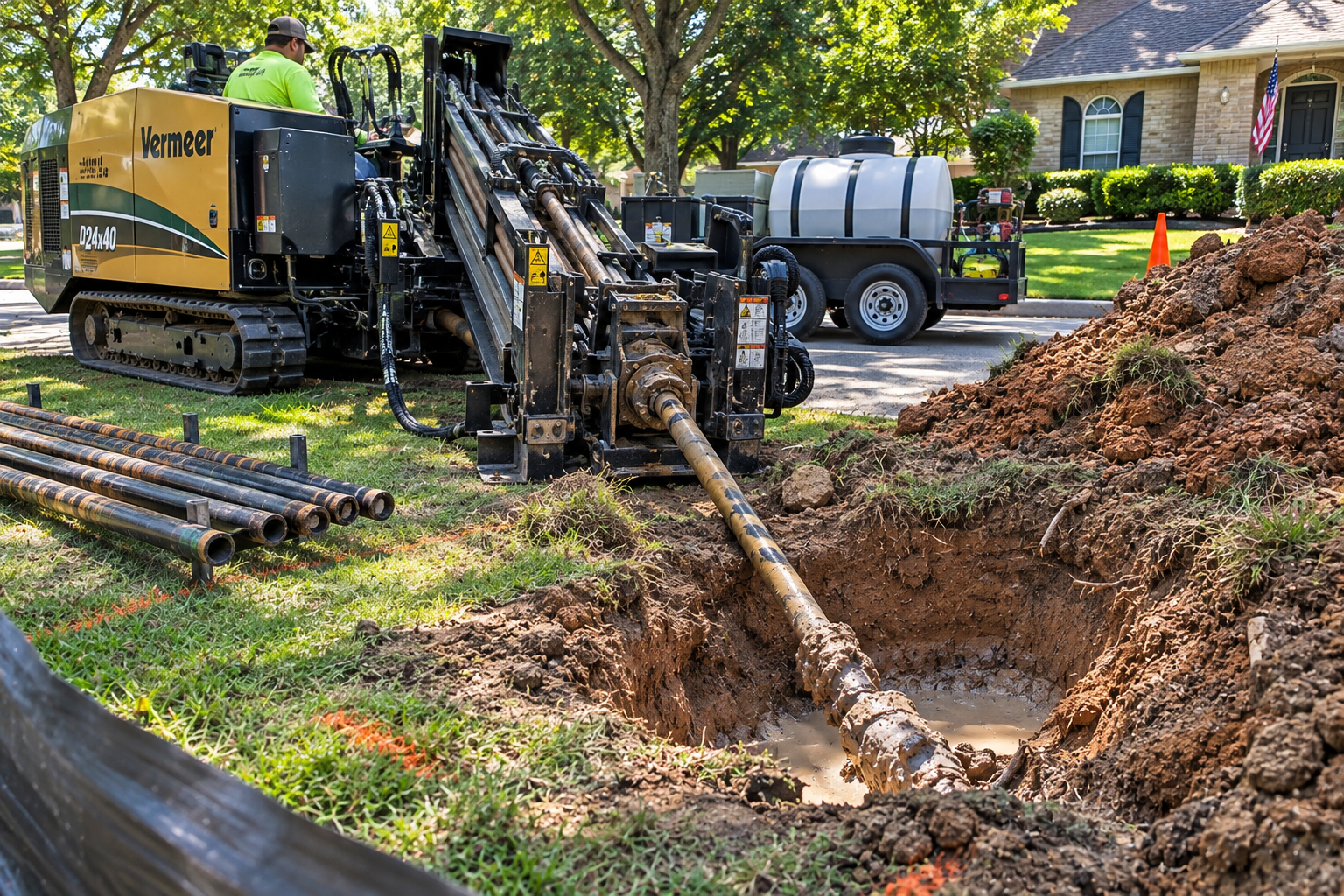
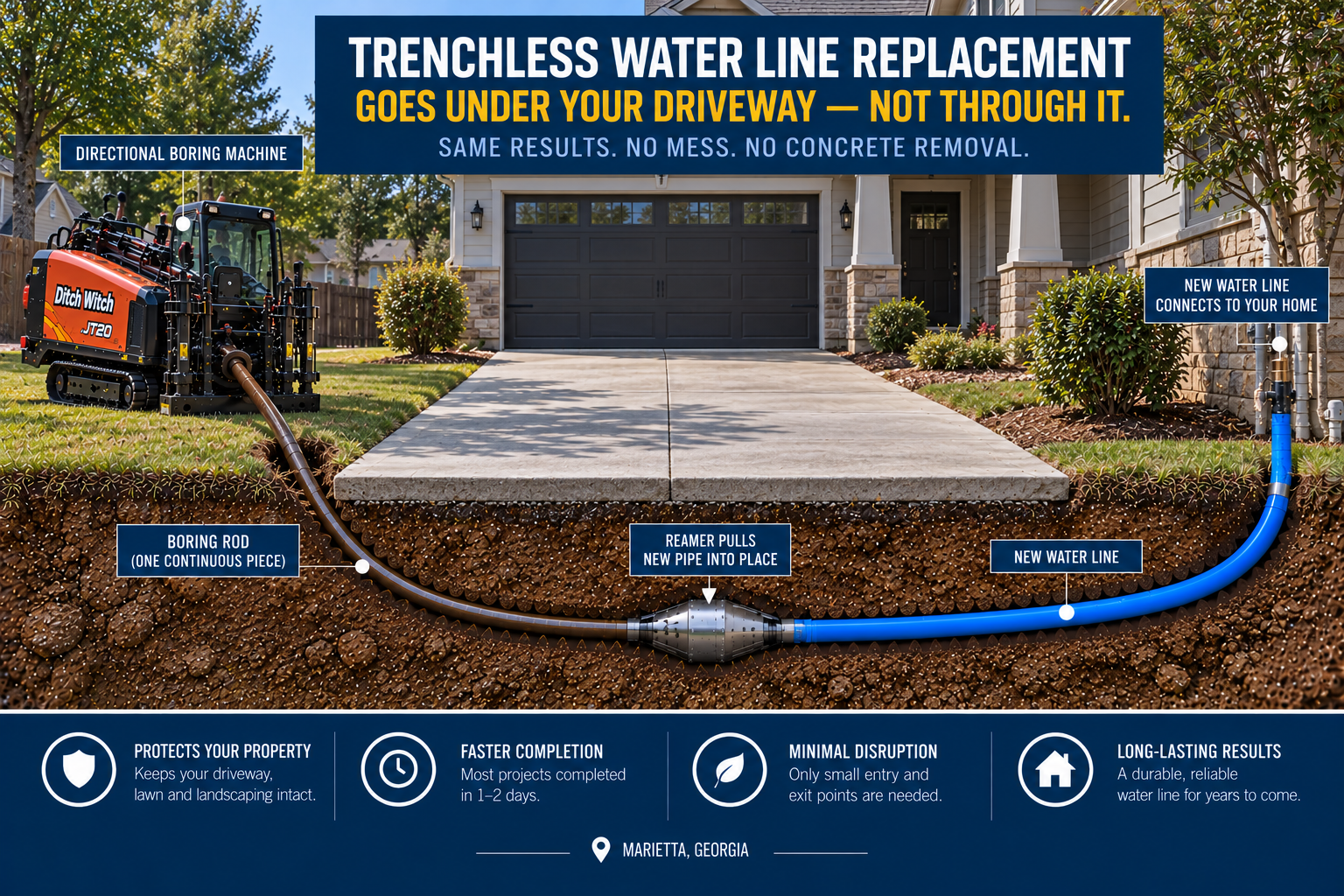
Entry and exit pits are dug, a boring machine drills a guided path between them, and the new pipe is pulled through and connected.
Driveway & Hardscape Crossings
Boring tends to be the better choice when the shortest path crosses a driveway, patio, or landscaping worth protecting.
Boring vs. Open Trench
Open trench excavates the entire path between two points; boring drills a fresh route through undisturbed ground.
Boring vs. Trenchless Replacement
Boring runs a new line along a guided path, often under a driveway or patio; trenchless replacement replaces an existing line by installing a new one alongside it.
Site Limitations Assessment
Soil and rock conditions, utility clearance, path length and depth, and equipment access can all limit or rule out boring for a specific path.
Permits for Boring
Installing a new water line, whether by open trench or boring, requires a plumbing permit in the City of Marietta.
What Affects the Boring Cost
Boring cost depends heavily on the specific path, but the factors that typically drive it are the same ones that determine feasibility.
- Path Length & Depth
- Access
- Soil & Rock Conditions
- Equipment Mobilization
Underground Specialists
Focused specifically on water-service-line repair, replacement, and trenchless work.
Clear Next Steps
We help you understand your options before any work starts.
No-Pressure Contact
Reach out by phone, text, or form — there's no obligation to move forward.
Trenchless Options
Minimal-disruption methods available when a property qualifies.
Related Underground Services
- Trenchless Water Line ReplacementReplacing a line through small access points instead of a full open trench.
- Main Water Line ReplacementFull line replacement, open-trench or trenchless, when repair no longer makes sense.
- Underground Water Line RepairSymptoms, diagnosis, and repair options for a failing underground water line.
- Underground Leak DetectionMeter testing, acoustic equipment, and line locating before any digging starts.
Helpful Resources
Learn more about underground water lines in Marietta and make informed decisions about your project.
- Trenchless vs. Open Trench Water Line ReplacementHow trenchless and open-trench water line replacement actually compare — landscaping impact, scope of excavation, and when each is the right fit.
- Marietta Water Line Permits: What's RequiredWhen a permit is required for water-line work in Marietta, who applies for it, and how to check whether City of Marietta or Cobb County rules apply.
- How to Check Your Water Meter for a LeakA step-by-step meter test to confirm a leak, and how to narrow down whether it's inside the house or in the underground line.
- Repair vs. Replace: How to Decide on Your Main Water LineA factor-by-factor comparison to help weigh a targeted spot repair against full water line replacement.
- Signs of an Underground Water Line LeakA room-by-room and yard checklist for recognizing an underground water line leak before it becomes a bigger repair.
- Water Leaking in the Yard: Is It Your Water Line?How to tell a genuine underground water-line leak apart from drainage, irrigation, or rain runoff — and what to do once you're fairly sure.
- Who's Responsible for the Water Line From Meter to House?The public main vs. the property owner's line — and why your Marietta address doesn't always tell you which authority applies.
Directional Boring FAQ
Common questions about directional boring in Marietta.
Need a New Line Under a Driveway or Patio?
Reach out and we'll help determine whether directional boring fits your property — no obligation to move forward.
What Directional Boring Is
Directional boring is an installation method, not a repair method. It installs a new pipe along a new path underground, without digging a continuous open trench above it — most often chosen when the ideal new path runs under a driveway, patio, or mature landscaping.
This distinguishes it from trenchless water line replacement, which replaces an existing line by installing a new one alongside it. If the line in question is a failing sewer line, see trenchless sewer line replacement.
Directional Boring Process
Entry and exit pits are dug, a boring machine drills a guided path between them, and the new pipe is pulled through and connected.
Driveway & Hardscape Crossings
Boring tends to be the better choice when the shortest path crosses a driveway, patio, or landscaping worth protecting.
Boring vs. Open Trench
Open trench excavates the entire path between two points; boring drills a fresh route through undisturbed ground.
Boring vs. Trenchless Replacement
Boring runs a new line along a guided path, often under a driveway or patio; trenchless replacement replaces an existing line by installing a new one alongside it.
Site Limitations Assessment
Soil and rock conditions, utility clearance, path length and depth, and equipment access can all limit or rule out boring for a specific path.
Permits for Boring
Installing a new water line, whether by open trench or boring, requires a plumbing permit in the City of Marietta.
What Affects the Boring Cost
Boring cost depends heavily on the specific path, but the factors that typically drive it are the same ones that determine feasibility.
- Path Length & Depth
- Access
- Soil & Rock Conditions
- Equipment Mobilization
Underground Specialists
Focused specifically on water-service-line repair, replacement, and trenchless work.
Clear Next Steps
We help you understand your options before any work starts.
No-Pressure Contact
Reach out by phone, text, or form — there's no obligation to move forward.
Trenchless Options
Minimal-disruption methods available when a property qualifies.
Related Underground Services
- Trenchless Water Line ReplacementReplacing a line through small access points instead of a full open trench.
- Main Water Line ReplacementFull line replacement, open-trench or trenchless, when repair no longer makes sense.
- Underground Water Line RepairSymptoms, diagnosis, and repair options for a failing underground water line.
- Underground Leak DetectionMeter testing, acoustic equipment, and line locating before any digging starts.
Helpful Resources
Learn more about underground water lines in Marietta and make informed decisions about your project.
- Trenchless vs. Open Trench Water Line ReplacementHow trenchless and open-trench water line replacement actually compare — landscaping impact, scope of excavation, and when each is the right fit.
- Marietta Water Line Permits: What's RequiredWhen a permit is required for water-line work in Marietta, who applies for it, and how to check whether City of Marietta or Cobb County rules apply.
- How to Check Your Water Meter for a LeakA step-by-step meter test to confirm a leak, and how to narrow down whether it's inside the house or in the underground line.
- Repair vs. Replace: How to Decide on Your Main Water LineA factor-by-factor comparison to help weigh a targeted spot repair against full water line replacement.
- Signs of an Underground Water Line LeakA room-by-room and yard checklist for recognizing an underground water line leak before it becomes a bigger repair.
- Water Leaking in the Yard: Is It Your Water Line?How to tell a genuine underground water-line leak apart from drainage, irrigation, or rain runoff — and what to do once you're fairly sure.
- Who's Responsible for the Water Line From Meter to House?The public main vs. the property owner's line — and why your Marietta address doesn't always tell you which authority applies.
Directional Boring FAQ
Common questions about directional boring in Marietta.
Is directional boring the same as trenchless replacement?
They're related but used for different purposes. Directional boring is an installation method generally used to run a new line along a new path, such as under a driveway, while trenchless replacement is replacing an existing line by installing a new one alongside it.
When would boring be chosen over open-trench installation?
Boring tends to be chosen when the new line's path needs to cross something worth protecting from excavation — a driveway, patio, mature landscaping, or other hardscaping.
Can directional boring go under anything?
No. Soil and rock conditions, the presence of other buried utilities along the bored path, and the depth and length required can all affect whether boring is workable for a specific path.
Does boring work in Marietta's clay soil?
Boring is a commonly used method in clay-heavy soils generally, though every property's specific soil and site conditions still need to be assessed individually.
Does directional boring cost more than open-trench installation?
It depends on the path length, depth, and equipment needed, so we won't generalize a comparison here.
Can directional boring be used for a repair instead of a new installation?
No. Boring installs new pipe, so it isn't a repair method for an existing line. If an existing line has failed, see underground water line repair or trenchless water line replacement instead.
Need a New Line Under a Driveway or Patio?
Reach out and we'll help determine whether directional boring fits your property — no obligation to move forward.
Call (770) 676-1685