
Sewer Line Replacement in Marietta, GA
When a sewer line is failing along its length, patching it again and again stops making sense. Here's how a full open-trench replacement works and when it's the right call.
What Sewer Line Replacement Means
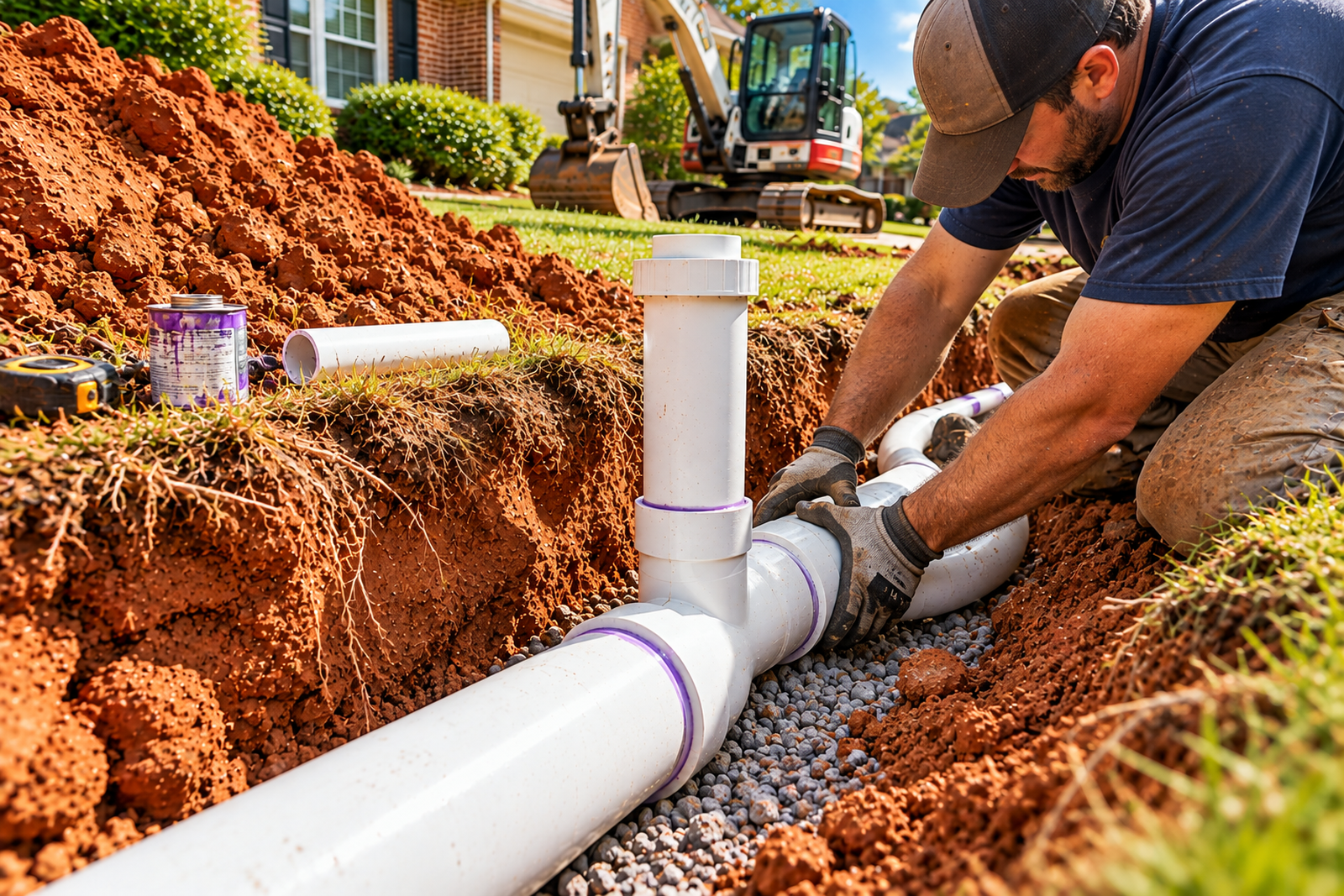
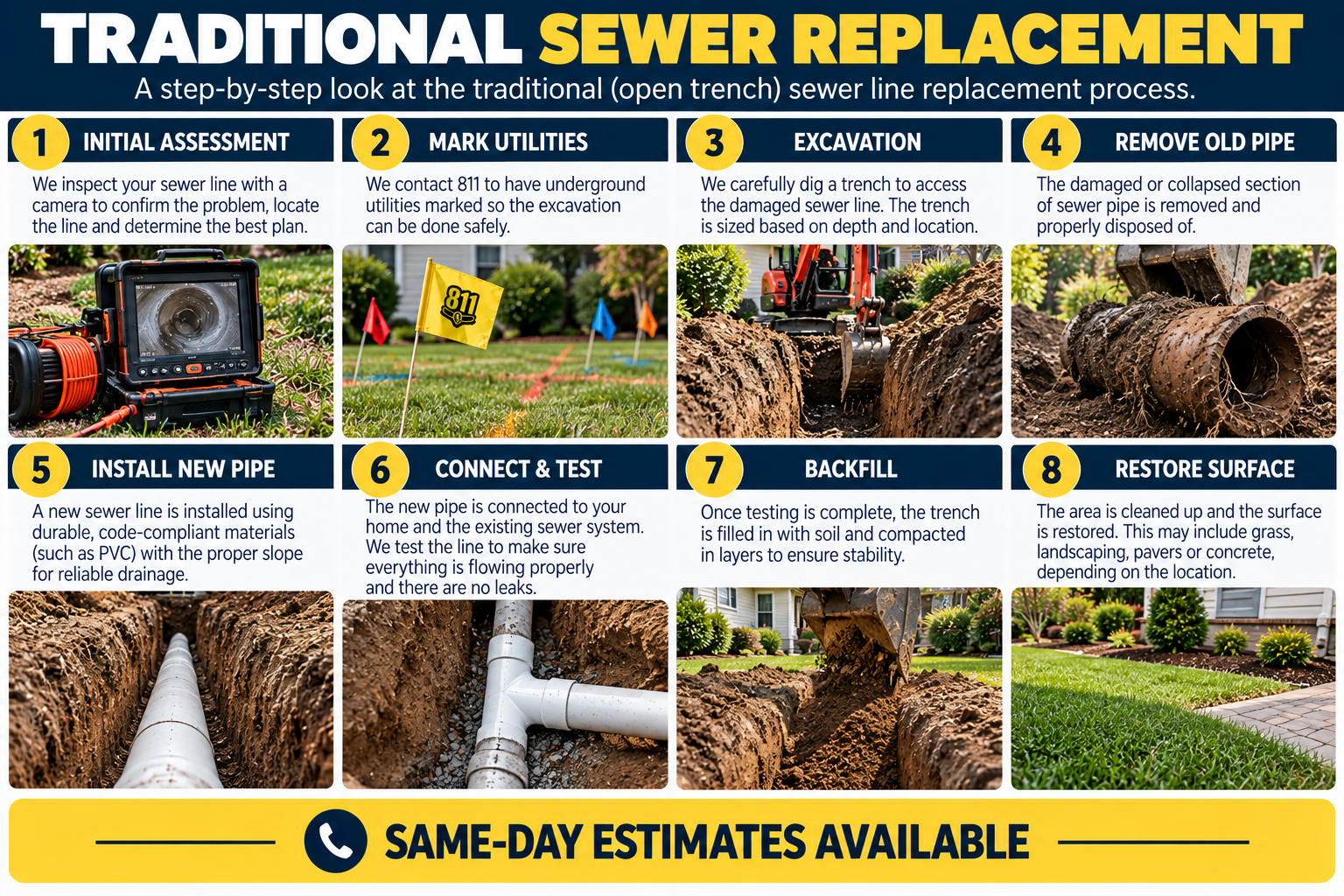
Sewer line replacement means installing a new sewer lateral from the house to the point where it connects to the public sewer, rather than fixing one failed spot. In a traditional (open-trench) replacement, the old line's path is excavated, the old pipe is removed, and new pipe is laid in a prepared trench at a continuous downhill slope, then connected at both ends, tested, inspected, and backfilled.
Replacement makes sense when the line has failed in more than one place, when the pipe material or condition is poor throughout, or when it keeps backing up after repairs and cleanings. It also tends to come up when a line has collapsed or when an assessment shows the pipe has sagged or shifted along much of its length.
If only a single spot has failed, a sewer line repair may be enough. If you'd rather avoid a long open trench, ask whether your property is a candidate for trenchless sewer line replacement. Our guide to repair vs. replacement compares the two decisions in detail.
Replacement Assessment
The scope comes from what's found on-site: the line's path, depth, and condition. A camera inspection may be recommended when needed.
Open-Trench Installation
The full path of the old line is excavated so the new pipe can be set on a prepared bed and sloped correctly along its entire length.
Correcting Sags & Low Spots
Because the entire run is open, the installer can see the whole line and set the slope correctly along the full length of the new pipe.
Connections & Cleanouts
The new line is tied in at the house and at the sewer connection. A properly placed cleanout gives future access for inspection and maintenance.
Testing, Permit & Inspection
The work is permitted, and the open trench stays accessible until the required inspection is complete and the pipe has been tested.
Backfill & Restoration
The trench is backfilled in controlled layers and the surface is restored. What restoration includes is agreed up front for the property.
What Affects a Sewer Replacement Project
Replacement cost and timing vary too much from one property to the next to generalize. These are the factors that drive them.
In the Marietta area, red clay, tree roots, and tight spacing between the house, driveway, and neighboring utilities are common site factors. Each is evaluated on the property rather than assumed.
- Length of the Line
- Depth & Slope
- What's on Top of the Line
- Soil & Obstructions
- Connection Points
Underground Specialists
Focused on buried lines: water and sewer repair, replacement, and trenchless work.
Clear Next Steps
We help you understand your options before any work starts.
Open-Trench & Trenchless
Both traditional excavation and trenchless replacement are available, depending on the property.
No-Pressure Contact
Reach out by phone, text, or form. There's no obligation to move forward.
 Tap to enlargeClick to enlarge
Related Underground Services
- Sewer Line RepairTargeted repair of a cracked, offset, or root-damaged section of sewer line.
- Trenchless Sewer Line ReplacementInstalling a new sewer line alongside the old one with minimal yard disruption.
- Trenchless Sewer Line RepairFixing a damaged sewer line with a new pipe installed alongside it, with minimal digging.
- Directional BoringInstalling a new line under a driveway or hardscaping without tearing it up.
- Main Water Line ReplacementFull line replacement, open-trench or trenchless, when repair no longer makes sense.
Helpful Resources
Learn more about underground water lines in Marietta and make informed decisions about your project.
- Sewer Line Repair vs. Replacement: How to DecideA factor-by-factor comparison to help weigh a targeted sewer repair against replacing the whole line.
- Trenchless vs. Traditional Sewer Repair: What's the Difference?How trenchless sewer work compares with traditional excavation, and what makes a property a fit for either.
- Sewer Line Repair and Replacement Costs: What Drives the PriceWhat changes the cost of a sewer repair or replacement, what an estimate should spell out, and how to compare quotes fairly.
- Signs of a Broken Sewer Line: What Marietta Homeowners Should Watch ForThe indoor, yard, and drain warning signs of a broken or collapsing sewer line, and how to tell them apart from an ordinary clog.
Sewer Line Replacement FAQ
Common questions about replacing a sewer line in Marietta.
Is It Time to Replace Your Sewer Line?
Reach out and we'll help you understand whether replacement fits your line, with no obligation to move forward.
What Sewer Line Replacement Means
Sewer line replacement means installing a new sewer lateral from the house to the point where it connects to the public sewer, rather than fixing one failed spot. In a traditional (open-trench) replacement, the old line's path is excavated, the old pipe is removed, and new pipe is laid in a prepared trench at a continuous downhill slope, then connected at both ends, tested, inspected, and backfilled.
Replacement makes sense when the line has failed in more than one place, when the pipe material or condition is poor throughout, or when it keeps backing up after repairs and cleanings. It also tends to come up when a line has collapsed or when an assessment shows the pipe has sagged or shifted along much of its length.
If only a single spot has failed, a sewer line repair may be enough. If you'd rather avoid a long open trench, ask whether your property is a candidate for trenchless sewer line replacement. Our guide to repair vs. replacement compares the two decisions in detail.
Replacement Assessment
The scope comes from what's found on-site: the line's path, depth, and condition. A camera inspection may be recommended when needed.
Open-Trench Installation
The full path of the old line is excavated so the new pipe can be set on a prepared bed and sloped correctly along its entire length.
Correcting Sags & Low Spots
Because the entire run is open, the installer can see the whole line and set the slope correctly along the full length of the new pipe.
Connections & Cleanouts
The new line is tied in at the house and at the sewer connection. A properly placed cleanout gives future access for inspection and maintenance.
Testing, Permit & Inspection
The work is permitted, and the open trench stays accessible until the required inspection is complete and the pipe has been tested.
Backfill & Restoration
The trench is backfilled in controlled layers and the surface is restored. What restoration includes is agreed up front for the property.
What Affects a Sewer Replacement Project
Replacement cost and timing vary too much from one property to the next to generalize. These are the factors that drive them.
In the Marietta area, red clay, tree roots, and tight spacing between the house, driveway, and neighboring utilities are common site factors. Each is evaluated on the property rather than assumed.
- Length of the Line
- Depth & Slope
- What's on Top of the Line
- Soil & Obstructions
- Connection Points
Underground Specialists
Focused on buried lines: water and sewer repair, replacement, and trenchless work.
Clear Next Steps
We help you understand your options before any work starts.
Open-Trench & Trenchless
Both traditional excavation and trenchless replacement are available, depending on the property.
No-Pressure Contact
Reach out by phone, text, or form. There's no obligation to move forward.
Tap to enlargeClick to enlargeRelated Underground Services
- Sewer Line RepairTargeted repair of a cracked, offset, or root-damaged section of sewer line.
- Trenchless Sewer Line ReplacementInstalling a new sewer line alongside the old one with minimal yard disruption.
- Trenchless Sewer Line RepairFixing a damaged sewer line with a new pipe installed alongside it, with minimal digging.
- Directional BoringInstalling a new line under a driveway or hardscaping without tearing it up.
- Main Water Line ReplacementFull line replacement, open-trench or trenchless, when repair no longer makes sense.
Helpful Resources
Learn more about underground water lines in Marietta and make informed decisions about your project.
- Sewer Line Repair vs. Replacement: How to DecideA factor-by-factor comparison to help weigh a targeted sewer repair against replacing the whole line.
- Trenchless vs. Traditional Sewer Repair: What's the Difference?How trenchless sewer work compares with traditional excavation, and what makes a property a fit for either.
- Sewer Line Repair and Replacement Costs: What Drives the PriceWhat changes the cost of a sewer repair or replacement, what an estimate should spell out, and how to compare quotes fairly.
- Signs of a Broken Sewer Line: What Marietta Homeowners Should Watch ForThe indoor, yard, and drain warning signs of a broken or collapsing sewer line, and how to tell them apart from an ordinary clog.
Sewer Line Replacement FAQ
Common questions about replacing a sewer line in Marietta.
When should a sewer line be replaced instead of repaired?
Replacement is usually the better choice when the line has failed in multiple places, the pipe is in poor condition along most of its length, a section has collapsed, or backups keep returning after repairs. A single isolated failure on an otherwise sound line is more often a repair candidate.
What does a sewer line replacement include?
Locating utilities, permitting, excavating the line's path, removing the old pipe, installing the new pipe at a continuous slope, connecting it at the house and the sewer, testing, inspection, backfill, and surface restoration. The exact scope for your property is confirmed in an assessment.
Will my yard be dug up?
In an open-trench replacement, yes: the path of the line is excavated. If minimizing disturbance matters, ask whether your property qualifies for trenchless sewer line replacement, which limits digging to access pits.
What will the new sewer pipe be made of?
Modern installations commonly use plastic pipe such as PVC, but the material and specification are confirmed for your job and must meet local plumbing code.
Does replacement need a permit in Marietta?
Yes, for work in the City of Marietta. The City requires a plumbing permit for work on a plumbing system, and the license holder performing the work applies for it. Properties in unincorporated Cobb County follow a separate process, so confirm which applies to your address.
Why not just keep repairing it?
Repeated repairs on a line in poor condition can cost more over time than addressing the line as a whole, and each new break risks a new backup. See repair vs. replacement for how to weigh it.
Is It Time to Replace Your Sewer Line?
Reach out and we'll help you understand whether replacement fits your line, with no obligation to move forward.
Call (770) 676-1685