

Main Water Line Replacement in Marietta, GA
Some main lines have reached the point where another spot repair just buys a little time. Here's when full replacement makes more sense than repair, and what the process generally involves.
When Full Replacement Makes Sense
A single, well-isolated break is often better handled with a spot repair. Full replacement tends to be the better call after repeated failures, when the line is old, failure-prone material like galvanized steel, or when diagnostic work shows damage spread across a long section rather than one spot.
See repair vs. replace: how to decide for the full comparison.
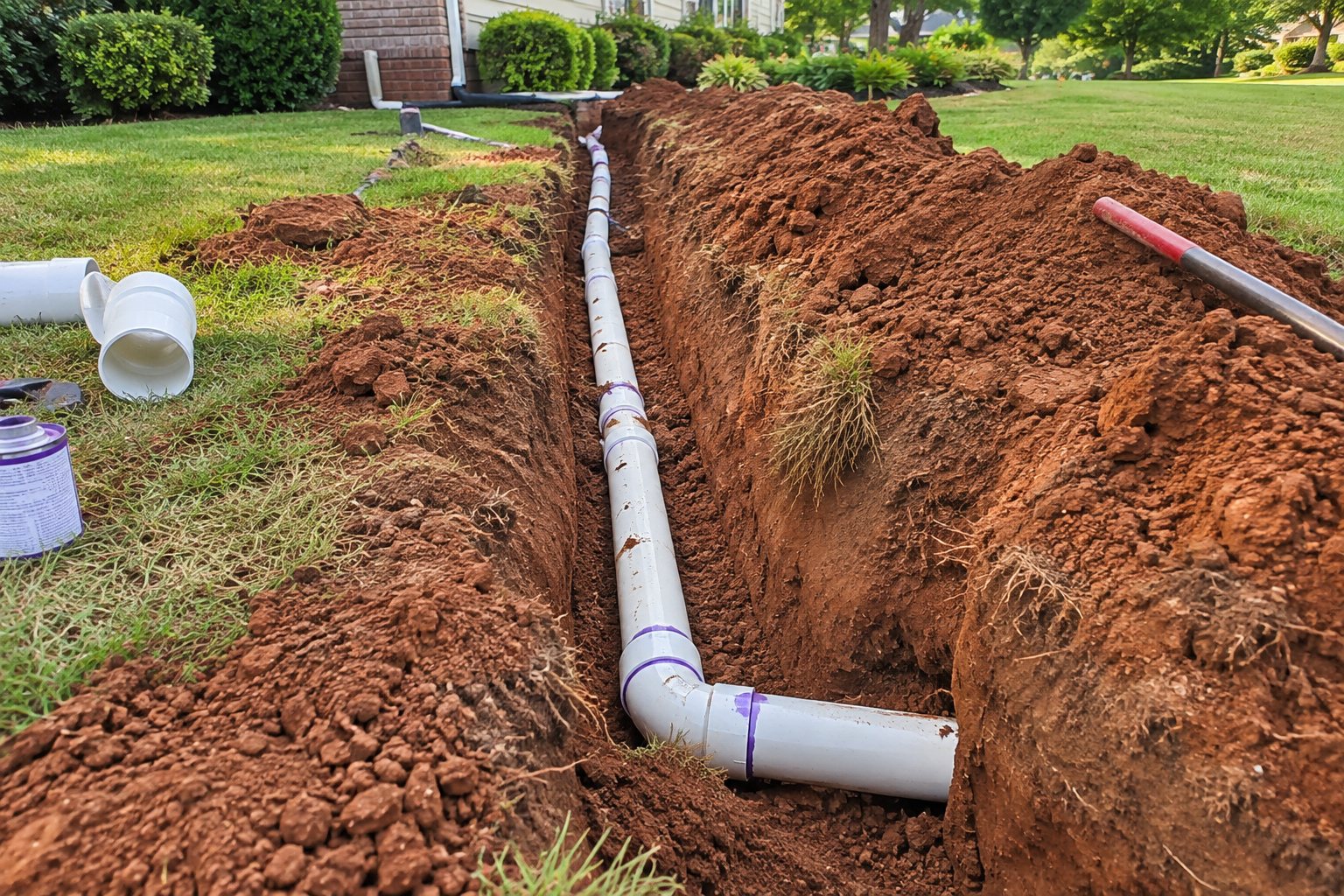
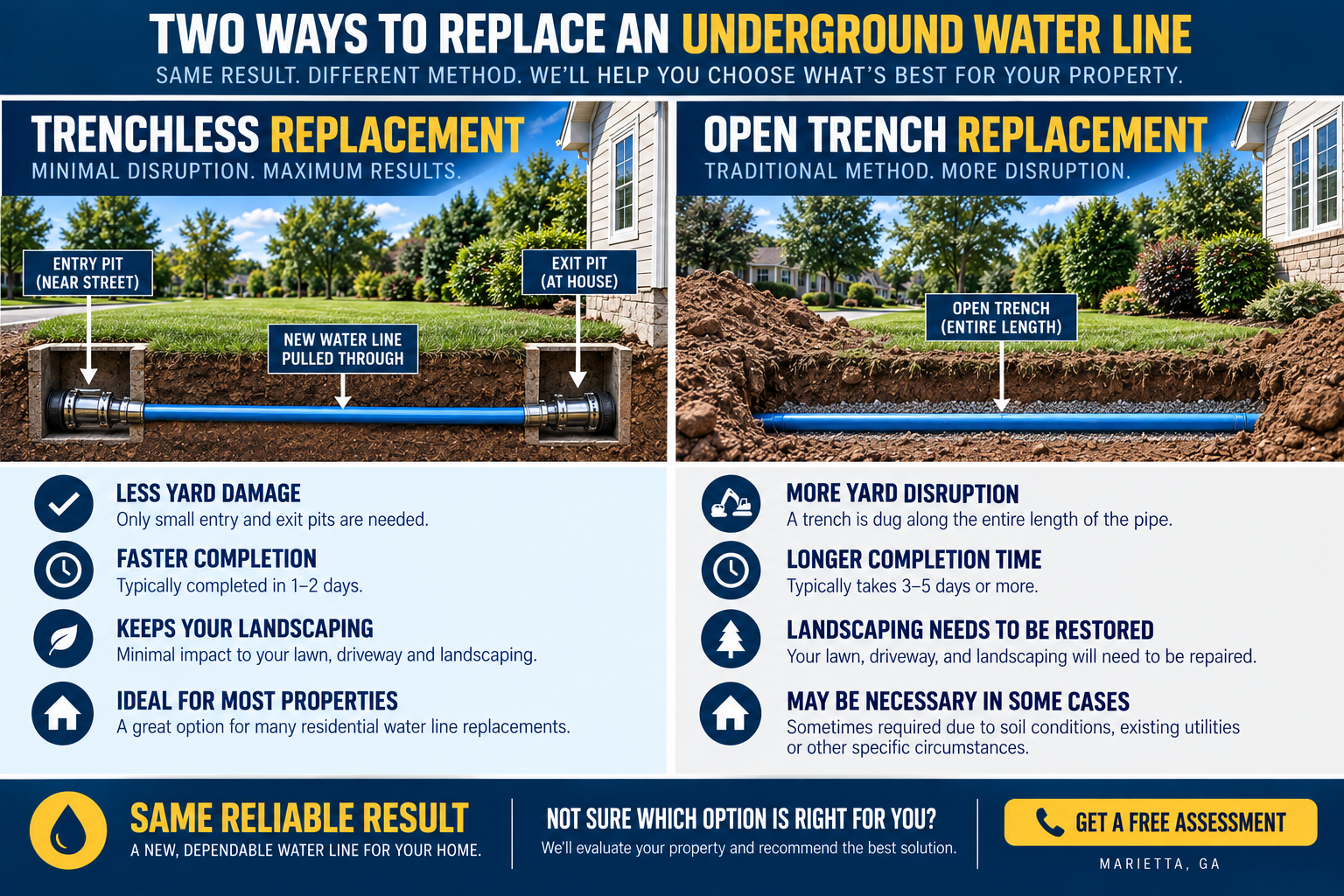
Open-Trench Replacement
A continuous trench along the line's path from the meter to the house, exposing the full run for a straightforward, well-understood installation.
Trenchless Replacement
Installing a new line through the existing path or a bored route using much smaller access points, usually with significantly less surface disruption.
Property Disruption Comparison
Open-trench work exposes the line's full length; trenchless and boring methods trade that for smaller entry and exit points.
Full Line Replacement Process
Locate the line, permit the work, excavate or bore, install the new line, connect, inspect, and restore the surface.
Replacement Cost Factors
Line length and depth, access, pipe material, and method all factor into the scope of a replacement — confirmed once the line is located and evaluated.
Permits & Jurisdiction
A plumbing permit is required in the City of Marietta, applied for by a licensed professional on the property's behalf.
What Affects the Replacement Cost
We don't quote pricing without seeing the property, but the same factors come up on nearly every replacement job.
- Line Length & Depth
- Access & Surface
- Pipe Material
- Method: Open-Trench vs. Trenchless
- Site Conditions
- Permitting
Underground Specialists
Focused specifically on water-service-line repair, replacement, and trenchless work.
Clear Next Steps
We help you understand your options before any work starts.
No-Pressure Contact
Reach out by phone, text, or form — there's no obligation to move forward.
Trenchless Options
Minimal-disruption methods available when a property qualifies.
Related Underground Services
- Main Water Line RepairSpot repair on the main service line when whole-house pressure or supply drops.
- Trenchless Water Line ReplacementReplacing a line through small access points instead of a full open trench.
- Directional BoringInstalling a new line under a driveway or hardscaping without tearing it up.
- Underground Leak DetectionMeter testing, acoustic equipment, and line locating before any digging starts.
Helpful Resources
Learn more about underground water lines in Marietta and make informed decisions about your project.
- Repair vs. Replace: How to Decide on Your Main Water LineA factor-by-factor comparison to help weigh a targeted spot repair against full water line replacement.
- Trenchless vs. Open Trench Water Line ReplacementHow trenchless and open-trench water line replacement actually compare — landscaping impact, scope of excavation, and when each is the right fit.
- Marietta Water Line Permits: What's RequiredWhen a permit is required for water-line work in Marietta, who applies for it, and how to check whether City of Marietta or Cobb County rules apply.
- How to Check Your Water Meter for a LeakA step-by-step meter test to confirm a leak, and how to narrow down whether it's inside the house or in the underground line.
- Signs of an Underground Water Line LeakA room-by-room and yard checklist for recognizing an underground water line leak before it becomes a bigger repair.
- Water Leaking in the Yard: Is It Your Water Line?How to tell a genuine underground water-line leak apart from drainage, irrigation, or rain runoff — and what to do once you're fairly sure.
- Who's Responsible for the Water Line From Meter to House?The public main vs. the property owner's line — and why your Marietta address doesn't always tell you which authority applies.
Main Water Line Replacement FAQ
Common questions about replacing a main water line in Marietta.
Considering a Full Line Replacement?
Reach out and we'll help you weigh open-trench vs. trenchless for your property — no obligation to move forward.
When Full Replacement Makes Sense
A single, well-isolated break is often better handled with a spot repair. Full replacement tends to be the better call after repeated failures, when the line is old, failure-prone material like galvanized steel, or when diagnostic work shows damage spread across a long section rather than one spot.
See repair vs. replace: how to decide for the full comparison.
Open-Trench Replacement
A continuous trench along the line's path from the meter to the house, exposing the full run for a straightforward, well-understood installation.
Trenchless Replacement
Installing a new line through the existing path or a bored route using much smaller access points, usually with significantly less surface disruption.
Property Disruption Comparison
Open-trench work exposes the line's full length; trenchless and boring methods trade that for smaller entry and exit points.
Full Line Replacement Process
Locate the line, permit the work, excavate or bore, install the new line, connect, inspect, and restore the surface.
Replacement Cost Factors
Line length and depth, access, pipe material, and method all factor into the scope of a replacement — confirmed once the line is located and evaluated.
Permits & Jurisdiction
A plumbing permit is required in the City of Marietta, applied for by a licensed professional on the property's behalf.
What Affects the Replacement Cost
We don't quote pricing without seeing the property, but the same factors come up on nearly every replacement job.
- Line Length & Depth
- Access & Surface
- Pipe Material
- Method: Open-Trench vs. Trenchless
- Site Conditions
- Permitting
Underground Specialists
Focused specifically on water-service-line repair, replacement, and trenchless work.
Clear Next Steps
We help you understand your options before any work starts.
No-Pressure Contact
Reach out by phone, text, or form — there's no obligation to move forward.
Trenchless Options
Minimal-disruption methods available when a property qualifies.
Related Underground Services
- Main Water Line RepairSpot repair on the main service line when whole-house pressure or supply drops.
- Trenchless Water Line ReplacementReplacing a line through small access points instead of a full open trench.
- Directional BoringInstalling a new line under a driveway or hardscaping without tearing it up.
- Underground Leak DetectionMeter testing, acoustic equipment, and line locating before any digging starts.
Helpful Resources
Learn more about underground water lines in Marietta and make informed decisions about your project.
- Repair vs. Replace: How to Decide on Your Main Water LineA factor-by-factor comparison to help weigh a targeted spot repair against full water line replacement.
- Trenchless vs. Open Trench Water Line ReplacementHow trenchless and open-trench water line replacement actually compare — landscaping impact, scope of excavation, and when each is the right fit.
- Marietta Water Line Permits: What's RequiredWhen a permit is required for water-line work in Marietta, who applies for it, and how to check whether City of Marietta or Cobb County rules apply.
- How to Check Your Water Meter for a LeakA step-by-step meter test to confirm a leak, and how to narrow down whether it's inside the house or in the underground line.
- Signs of an Underground Water Line LeakA room-by-room and yard checklist for recognizing an underground water line leak before it becomes a bigger repair.
- Water Leaking in the Yard: Is It Your Water Line?How to tell a genuine underground water-line leak apart from drainage, irrigation, or rain runoff — and what to do once you're fairly sure.
- Who's Responsible for the Water Line From Meter to House?The public main vs. the property owner's line — and why your Marietta address doesn't always tell you which authority applies.
Main Water Line Replacement FAQ
Common questions about replacing a main water line in Marietta.
How do I know if I need replacement instead of a repair?
Replacement generally makes more sense when the line has already failed more than once, is made of older material like galvanized steel that tends to fail again nearby even after a repair, or has damage spread across an extended section rather than one spot.
Does full replacement always mean digging a trench across my whole yard?
No. Traditional open-trench replacement does involve a continuous trench along the line's path, but trenchless methods can install a new line through much smaller access points.
Will replacing the main line disrupt my driveway or landscaping?
It depends on the method and the line's path. Open-trench work along a path that crosses a driveway or walkway may require cutting and patching that surface. Trenchless and directional boring methods are specifically aimed at reducing this kind of disruption.
How long does main line replacement generally take?
It varies by property, line length, access, and method, so we won't quote a specific day count here. The work moves through locating the line, permitting, excavating or boring, installing the new line, connecting and testing it, and restoring the surface.
What affects the cost of main line replacement?
Line length and depth, how much excavation or boring the property allows, the pipe material used, whether the job is open-trench or trenchless, and any permitting or site-condition factors all play into the scope of a replacement.
Is trenchless replacement always more expensive than open-trench?
Not necessarily, and it depends on the property. Trenchless work uses specialized equipment, but open-trench work on a long run with a driveway crossing to cut and patch can add its own cost.
Considering a Full Line Replacement?
Reach out and we'll help you weigh open-trench vs. trenchless for your property — no obligation to move forward.
Call (770) 676-1685